- The Talent Ledger
- Posts
- The Trust Test
The Trust Test
Why integrity compounds more than any growth hack

William Stringer
December 31, 2025

𝐖𝐞𝐞𝐤𝐥𝐲 𝐓𝐚𝐤𝐞
Two founders. Same market. Same early growth.
Some of the best founders are intense, impatient, and unreasonably demanding. That's often what it takes. Building something new means fighting inertia, and the people who win that fight are rarely chill.
You can be hard to work with. You can't be hard to trust.
This week, we're examining two founders with comparable traction but completely different approaches to people. One built with partners. The other burned through them.
𝐅𝐨𝐮𝐧𝐝𝐞𝐫 𝐏𝐫𝐨𝐟𝐢𝐥𝐞𝐬
Founder A | Founder B |
|---|---|
📅 Age: Mid 30s | 📅 Age: Mid 20s |
📍 Geography: East Coast | 📍 Geography: West Coast |
📈 Stage: 30 paying users, $7K MRR | 📊 Stage: 25 early access teams, $5K MRR |
💼 Industry: B2B SaaS workflow automation | 🎨 Industry: B2B SaaS collaboration tools |
🎓 Background: Ex-management consultant, prior service business exit, technical cofounder | 🎓 Background: Product and design, prior startup experience |
🔥 X-Factor: Fair, honest, and accountable team player | 💡 X-Factor: Strong product vision |
𝐓𝐡𝐞 𝐃𝐨𝐰𝐧𝐥𝐨𝐚𝐝
𝐅𝐨𝐮𝐧𝐝𝐞𝐫 𝐀: 𝐘𝐞𝐬 ✅
This founder built a workflow automation platform targeting independent consultants and solo firms. The product is self-built with clear product-market fit in a niche vertical.
The traction wasn't flashy but the foundation was trustworthy. They communicated transparently, collaborated with their cofounder as a true partner, and showed resilience when early customer development didn't go as planned.
What stood out was the reference checks. Every person I spoke to described them as fair, honest, and accountable. In tough moments - cap table discussions, early pivots, customer conflicts - they consistently chose to grow the pie rather than optimize for themselves.
This founder operates with long-term trust in mind. These decisions don't show up in pitch decks, but they show up in staying power. I'd rather back someone who makes 80% of the right moves rather than someone who's 100% right but burns bridges.
This founder builds value with people, not at the expense of them, and this is why I said yes.
𝐅𝐨𝐮𝐧𝐝𝐞𝐫 𝐁: 𝐍𝐨 ❌
This founder built collaboration tooling for small design teams. They'd raised capital from angels and had early access teams testing the product. The vision was clear, and the product design was thoughtful.
On paper, it looked comparable to Founder A. Similar stage, similar metrics, similar backgrounds.
But the warning signs stacked up. Three cofounder breakups across two prior ventures. The feedback from prior cofounders was consistent: controlling, unwilling to compromise, extractive in cap table splits. They'd structured deals where they held disproportionate equity despite comparable contributions.
On calls, the founder projected confidence. But when pressed about the cofounder departures and decision-making process, the tone shifted fast. Everything became adversarial. Every question felt like an attack. That doesn't work when you're pre-product/market fit and still building a team.
The upside doesn't outweigh the fragility of a founder who can't build with others—and this is why I said no.
𝐌𝐲 𝐑𝐮𝐛𝐫𝐢𝐤
𝐀 𝐯𝐢𝐬𝐮𝐚𝐥 𝐛𝐫𝐞𝐚𝐤𝐝𝐨𝐰𝐧 𝐨𝐟 𝐤𝐞𝐲 𝐟𝐚𝐜𝐭𝐨𝐫𝐬 𝐢𝐧 𝐦𝐲 𝐢𝐧𝐯𝐞𝐬𝐭𝐦𝐞𝐧𝐭 𝐝𝐞𝐜𝐢𝐬𝐢𝐨𝐧
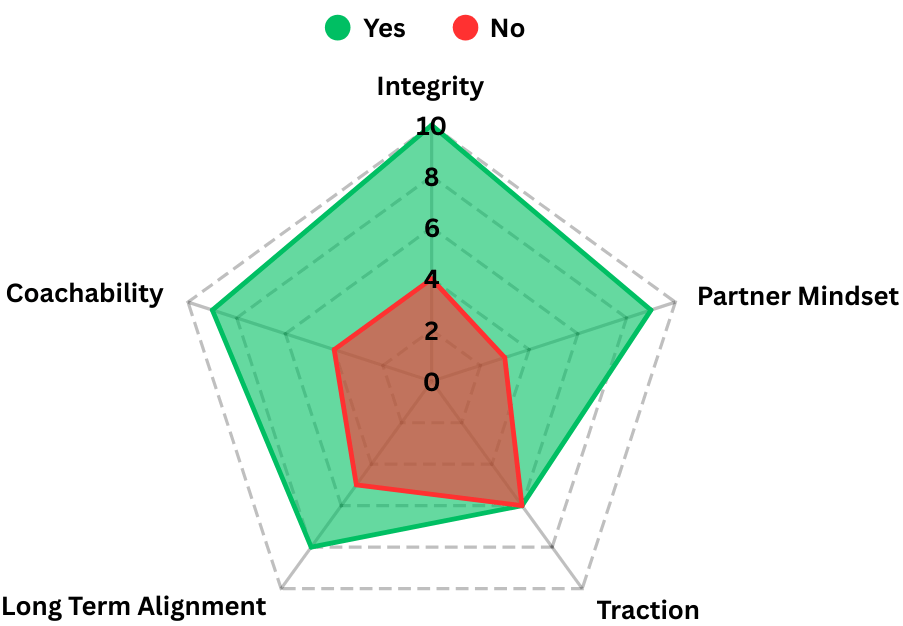
This comparison shows how character and partner mindset outweigh comparable traction when building something that requires sustained collaboration
𝐄𝐧𝐠𝐚𝐠𝐞𝐦𝐞𝐧𝐭 𝐂𝐨𝐫𝐧𝐞𝐫
𝐐: 𝐖𝐡𝐚𝐭 𝐚𝐫𝐞 𝐭𝐡𝐞 𝐞𝐚𝐫𝐥𝐲 𝐰𝐚𝐫𝐧𝐢𝐧𝐠 𝐬𝐢𝐠𝐧𝐚𝐥𝐬 𝐨𝐟 𝐚 𝐳𝐞𝐫𝐨-𝐬𝐮𝐦 𝐟𝐨𝐮𝐧𝐝𝐞𝐫?
Listen to how they talk about former cofounders or teammates. Zero-sum founders externalize blame. Partner-minded founders take ownership for their part in what went wrong, even when the other person was difficult.
Pay attention to language. "I built this" versus "We built this" tells you everything about how someone sees value creation. Zero-sum founders claim credit and deflect responsibility. Partner-minded founders share both.
Watch what happens when you challenge them. Do they engage thoughtfully or get defensive? The clearest signal: talk to people who've worked with them before. Not just the references they provide, the ones they don't.
𝐅𝐞𝐞𝐝𝐛𝐚𝐜𝐤
Did you enjoy this issue?Your feedback will be used to refine this newsletter. |
𝐂𝐥𝐨𝐬𝐢𝐧𝐠 𝐓𝐡𝐨𝐮𝐠𝐡𝐭𝐬
Ego, friction, early chaos - fine. Cutting corners, screwing partners, optimizing for self at the expense of others - not fine.
Those aren't personality traits. They're character traits. And they don't disappear when the company scales. They only get worse.
When traction looks the same, integrity is the edge. It compounds quietly and unlocks more than any growth hack ever will.
Auditing more talent next week,
Will Stringer

P.S. If you found value in this entry, add it to someone else's ledger by forwarding this email. If you're that someone, subscribe here to get inside access to how I invest in exceptional people.